
Blackjack GEMBET revolves around the goal of bringing the total value of the cards as close to 21 as possible without exceeding the limit. GEMBET applies specific table rules to determine when to draw, stand, split, and how the dealer handles the cards. Cards from 2 to 10 retain their face values, J, Q, and K are worth 10, while the Ace can flexibly count as either 1 or 11.
What Steps Does a Blackjack GEMBET Round Follow?
Each Blackjack GEMBET round begins with the dealing phase before moving to the participant’s decision-making turn. The goal is to create a hand closer to 21 than the dealer while keeping the total within the valid range.
Dealing the two initial cards
Once betting closes, the player and dealer receive cards according to the sequence specified at the table. Members typically receive two initial cards, while the dealer has one face-up card to provide information for the next decision.
If Blackjack GEMBET produces A-K, A-Q, A-J, or A-10 from the first two cards, the hand qualifies as a natural Blackjack. In contrast, 10-7 creates 17 points even though the total is relatively close to the upper limit of 21.
Choosing hit or stand
Hit allows the player to receive another card, while Stand keeps the current total and moves the hand to the next stage. For example, an 8-5 hand totals 13 points, and receiving a 6 after choosing Hit raises the total to 19.
When playing Blackjack GEMBET, any hand exceeding 21 enters the Bust state under standard rules. A member who chooses Stand receives no additional cards even though the dealer may later reach a higher total.

Double When Blackjack GEMBET Conditions Are Met
Double generally allows the player to increase the wager according to the table rules and receive exactly one additional card before standing. For example, a 6-5 hand totals 11 points, and receiving a 10 after Double produces a final total of 21.
Blackjack GEMBET may specify the eligible point ranges or situations for Double depending on the version currently available. Players should check whether the action button remains available before confirming rather than assuming every hand supports Double.
Split when holding a pair
Split separates two qualifying cards into two independent hands, with each side then receiving additional cards according to the designated sequence. For example, a pair of 8-8 can be divided into two separate hands instead of keeping the initial total of 16.
Each hand after the split is handled independently through Hit, Stand, or Double according to the table rules. Splitting Aces often comes with separate rules regarding additional cards and whether a natural Blackjack can be formed.
How Does Blackjack GEMBET Determine the Result?
Blackjack GEMBET determines the result by comparing the player’s valid hand with the dealer’s hand after all decisions have been completed. The closer the total is to 21, the stronger the hand, but a natural Blackjack must be distinguished from a 21 formed with multiple cards.

- Natural Blackjack: The first two cards consist of an Ace combined with a 10, J, Q, or K, creating exactly 21 points.
- Regular 21: A 7-5-9 hand also totals 21, but it is formed with three cards rather than two initial cards.
- Player Bust: A 10-8 hand that receives a 5 reaches 23, exceeding the 21-point limit and resulting in a loss.
- Dealer Bust: When the dealer reaches 22 or more, valid player hands are handled according to the applicable table rules.
- Player Higher: A hand totaling 20 beats a dealer’s 18 when both sides remain valid and there is no special Blackjack.
- Dealer Higher: A hand totaling 17 loses to a dealer’s 19 because the dealer is closer to 21 without exceeding the limit.
- Equal Totals: When the player reaches 19 and the dealer also has 19, the result is generally a Push under common Blackjack rules.
- Blackjack on Both Sides: If both sides have a natural Blackjack, the round is generally settled as a tie according to the applicable rules.
- Dealer Has Blackjack: A player’s 21 formed from multiple cards is not treated as equivalent to the dealer’s natural Blackjack.
Special Situations to Watch for at the Blackjack Table
Certain states create additional options or require the dealer to follow predetermined procedures. Members should observe the face-up card, current total, and available action buttons before making a decision.
Dealer shows an ace
A face-up Ace indicates that the dealer has a flexible value of either 1 or 11 before the remaining card is revealed. Some tables may offer Insurance when the dealer shows an Ace, with separate payout rules displayed at the table. Blackjack GEMBET handles this option according to the rules of the specific version rather than combining it with the main hand.
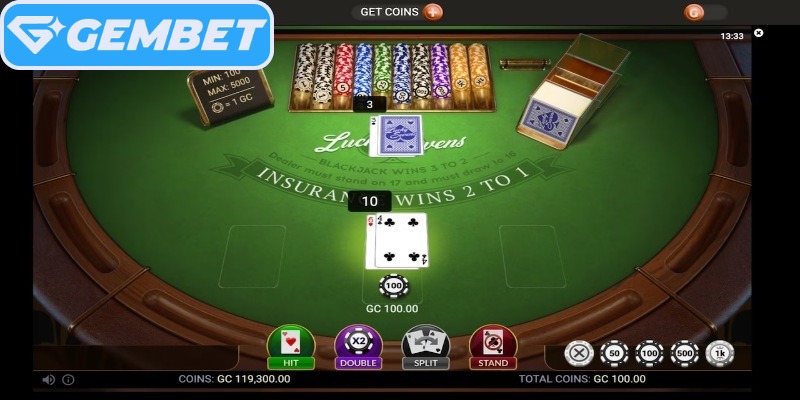
Two cards of the same value
When the first two cards meet the conditions for Split, the system may display a button allowing the hand to be divided into two independent hands. For example, 7-7 creates 14 points, but after Split, each 7 becomes the starting card of a separate hand. Players using Blackjack GEMBET then receive additional cards for each side according to the sequence specified by the table.
Double after split
After a Split, the availability of Double depends on the table’s specific rules rather than being automatically offered for every hand. For example, one branch starting with 5 may receive a 6 to reach 11 points, at which point the Double button may appear if permitted by the rules. Blackjack GEMBET directly displays the actions available based on the current state of each hand.
Dealer reaches 17 points
The dealer does not independently choose between Hit and Stand but must follow the fixed rules published at the table. Many versions require the dealer to Stand on Hard 17, while the treatment of Soft 17 may vary depending on the rules. Members should check whether the table requires the dealer to Stand or Hit on Soft 17. The difference occurs when an Ace is being counted as 11, such as A-6 creating a Soft 17.
Conclusion
Blackjack GEMBET uses the 21-point limit together with Hit, Stand, Double, and Split actions to operate each round. Situations involving Aces, Split, or Soft 17 may depend on the specific rules established by the table. GEMBET displays the applicable rules so members can review each hand before the system determines the final outcome.